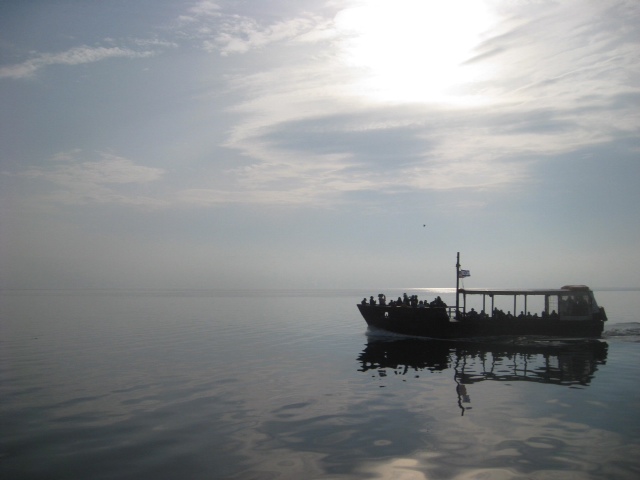
One of the things you notice as you travel throughout Israel is the closeness of the borders. On Tuesday, we travelled up into the Golan Heights to the Valley of Tears, where a major battle in the Yom Kippur War in 1973 was fought. Less than an hour's drive from the Sea of Galilee, you stand and look past three abandoned tanks into Syria. Earlier in the day, we had looked north-west to Lebanon. Today we traveled down the Jordan Valley. To our left, sometimes within 30 feet, was a double fence, electrified, with land mines in between. Along it runs a sandy track, which is checked several times each day for the footprints of border-crossers from Jordan.
On our way from Jerusalem to Bethlehem, we crossed the border - and the wall - into Palestinian territory. Neither our guide nor our driver, who are Israeli, could enter; we had to pick up a new guide and driver for our time there. As we waited at the border to cross back into Israel, with machine gun toting soldiers passing through the bus, I was aware that for those residents of Bethlehem, who work in Jerusalem, just a couple of miles away, this is an everyday occurrence, and for Israeli Jew and Palestinian alike, it is a restriction and ofttimes indignity.
Whether you are Jewish, Palestinian, or non-religious living in Israel, you cannot avoid the understanding that you live among your traditional enemies. And that has been the case for thousands of years. Set at the crossroads between Europe, Asia and Africa, this land has often been fought over. Abraham entered a land that had been long settled by Canaanites; Moses led the people of God back to a promised land settled by Jebusites and Hittites and Hivites; David and Solomon had to defeat the Philistines; the prophets spoke to those who had experienced the land-hunger of the Babylonians and Persians and Assyrians. And Jesus lived in a country occupied by the Romans.
Against all that opposition, identity has always been something for which it was necessary to fight. Clear boundaries have been necessary - of language, law, and culture. As you travel this land you begin to understand why law and covenant were so important, setting a people apart for God. Here, identity has always been inexorably entwined with religion. And the faith that has grown in this soil is passionate and fiercely loyal to the God who calls it forth.
Which makes me wonder, what of our faith? For most of us, it has not been born in the context of enmity. Being Christian in America, we don't need such rigorous boundaries to maintain our faith. Most of our neighbors really don't care who or what we believe in. And the danger is that we too may cease to care.
Feb 17, 2011
Feb 16, 2011
Accretions...
Today we visited Tel Megiddo, an archaeological site where there are 26 or thereabouts (depending on which archaeologist you believe) layers of civilization. Inhabited from about 7000 BC to 586 BC, it is a mound created by fortress built upon fortress. The remains include an early Canaanite settlement with its large circular altar, a circular communal grain pit from its time as an Israelite fortress, and stables with stone drinking troughs from the reigns of Solomon and Ahab.
Later in the day, as I was walking through the town of Tiberias, I realized that most of the Christian sites that we have seen are layered like Tel Megiddo. The top layer is almost always a church, sometimes Roman Catholic, sometimes Greek Orthodox. Down a layer maybe a Crusader church, or perhaps a Byzantine one. Finally, perhaps down another couple of layers, are remains that date to the time of Christ. Sometimes it's a village, or a rock, or a well; sometimes accessible, sometimes hidden behind a gate or under the floor. Somewhere down there is a place that Jesus might actually have lived or visited.
Sometimes our faith is like Tel Megiddo. Way down at the bottom is the heart of our faith, our relationship with Jesus Christ himself. Sometimes that dates to our childhood; sometimes it is much more recent. But since then, layers have built up over that initial experience. The liturgical traditions that have become meaningful to us, the hymns that we love, the architecture that speaks to us, and the people who have shared our journey all shape our experience of faith. But there are times when those accretions threaten to overwhelm our core relationship; it is at those times that we need to stop and take time to simply talk with our Savior.
Meanwhile, I'm looking forward to Bethlehem, where apparently we will go down a long flight of stairs and see the exact place where Jesus was born. Maybe.
Later in the day, as I was walking through the town of Tiberias, I realized that most of the Christian sites that we have seen are layered like Tel Megiddo. The top layer is almost always a church, sometimes Roman Catholic, sometimes Greek Orthodox. Down a layer maybe a Crusader church, or perhaps a Byzantine one. Finally, perhaps down another couple of layers, are remains that date to the time of Christ. Sometimes it's a village, or a rock, or a well; sometimes accessible, sometimes hidden behind a gate or under the floor. Somewhere down there is a place that Jesus might actually have lived or visited.
Sometimes our faith is like Tel Megiddo. Way down at the bottom is the heart of our faith, our relationship with Jesus Christ himself. Sometimes that dates to our childhood; sometimes it is much more recent. But since then, layers have built up over that initial experience. The liturgical traditions that have become meaningful to us, the hymns that we love, the architecture that speaks to us, and the people who have shared our journey all shape our experience of faith. But there are times when those accretions threaten to overwhelm our core relationship; it is at those times that we need to stop and take time to simply talk with our Savior.
Meanwhile, I'm looking forward to Bethlehem, where apparently we will go down a long flight of stairs and see the exact place where Jesus was born. Maybe.
Feb 15, 2011
Fierce Landscapes
I'd always heard that Israel was a land of contrasts. But I'd always thought that was the classic cliched hyperbole that you expect from tourist advertising. Of course there are contrasts - few countries are geographically uniform. But what is striking is the sheer magnitude of the differences within a few miles. From the shores of the Sea of Galilee to the fertile headwaters of the Jordan to the abandoned Syrian tanks of the Golan Heights takes little more than an hour to drive.Somehow - I imagine thanks to my Children's Illustrated Bible - I had imagined this to be a more pastoral land, echoing the gentler contours of New England rather than the harsher reality of a land formed of volcanic eruption, earthquake, and erosion.
Imagine Jesus sailing on a lake that one moment is mirror still, and the next whipped by winds tearing past a hill that looks like it has been attacked with a meat cleaver, walking northwards through green fields spattered with stone, along a marshy stream that eventually becomes the Jordan River, and towards the cliff face in whose shadow the city of Caesarea Philippi was built, and where Peter confessed that Jesus was the Christ. His own understanding of himself and his mission must have been shaped by these places. No wonder that the Jesus of the gospels is not so much "Gentle Jesus, meek and mild" as a man of passion and grace in equal measure, one who healed a synagogue leader's beloved daughter and spoke woe on the scribes and the pharisees.
About ten years ago I read a book called "The Solace of Fierce Landscapes" by Belden Lane. In it, he speaks of the relationship between spirituality and landscape: the ways in which the way we experience God is shaped by our environment. The extremes of the land echo the extremes of our lives, birth and death, and their reverberations in between. And so often, it is in those extreme and liminal places that we not only meet God, but find our faith reshaped and renewed.
Feb 12, 2011
Blisters and blessings
Recently, I received a gift. It was a small paper crown, with one word written inside it - longanimity. It was the Sunday after the Epiphany. The priest in the church I visited invited each member of the congregation to take one of these crowns from a basket, and to receive the word written therein as a gift from God, to be lived with all year. I had to look up my word in the dictionary. It means "A disposition to bear injuries patiently" or "calmness in the face of suffering and adversity." I don't like my word.
But in the weeks since I received it, I've learned to live with it. And I've realized that it has a lot to do with the way you deal with the way you travel through life.
We Christians often talk about that journey through life as being a pilgrimage. However, I sometimes think that we use the word metaphorically, without thinking what pilgrimage is really like. When I think of pilgrimages, I think of richly colored medieval paintings, red and blue and green with gold leaf, people walking sturdily towards a golden-roofed city.
But in the last couple of years, I've walked two pilgrimage trails: St Cuthbert's Way in Scotland and north-eastern England, and Two Saints Way from Chester to Litchfield, also in England. They have not been like the medieval pictures in my head. My clothing is not rich red and blue and green with gold leaf. I have well-worn gray boots, gray shorts, a washed out blue T-shirt, and a gray hat. They're chosen for their practicality - they're quick to dry and don't show the dirt.
And my walking is not so sturdy, certainly not by the time I'm within sight of my destination. Limping would be a better word for it. No matter how good my preparations, walking 15 or so miles a day means that I get blisters. You learn to live with them, but you can't forget them.
But that's not the whole story of pilgrimage. When I crested the last hill before the sea, and saw Holy Island, when I received the Eucharist in a church where my ancestors were married and buried, when I stood on the windswept moors where St Cuthbert visited his parishioners, when I received unexpected hospitality - a short car ride, a cup of tea, a pint of beer - I knew the tangible blessing of God.
The pilgrimage we are on as Christians is one characterized by both blisters and blessings. Jesus never promised us that it would be easy. In fact, he has invited us to take on his yoke, to bear the cross, to rejoice in suffering - not as some sort of masochistic hazing ritual, but as full participation in the often strenuous and sometimes costly work of God that, in the words of Romans 8:1-5, produces endurance and character and hope, and in the end, a share in the glory of God. Or, in the words of the well known hymn,
Bane and blessing, pain and pleasure,
By the cross are sanctified;
Peace is there that knows no measure,
Joys that through all time abide.
John Bowring, 1825
Longanimity is about the blisters. And it seems that as soon as one heals, my shoes begin to rub again. But every time I crest another hill, I know the even greater blessings of the glorious grace of God.
But in the weeks since I received it, I've learned to live with it. And I've realized that it has a lot to do with the way you deal with the way you travel through life.
We Christians often talk about that journey through life as being a pilgrimage. However, I sometimes think that we use the word metaphorically, without thinking what pilgrimage is really like. When I think of pilgrimages, I think of richly colored medieval paintings, red and blue and green with gold leaf, people walking sturdily towards a golden-roofed city.
But in the last couple of years, I've walked two pilgrimage trails: St Cuthbert's Way in Scotland and north-eastern England, and Two Saints Way from Chester to Litchfield, also in England. They have not been like the medieval pictures in my head. My clothing is not rich red and blue and green with gold leaf. I have well-worn gray boots, gray shorts, a washed out blue T-shirt, and a gray hat. They're chosen for their practicality - they're quick to dry and don't show the dirt.
And my walking is not so sturdy, certainly not by the time I'm within sight of my destination. Limping would be a better word for it. No matter how good my preparations, walking 15 or so miles a day means that I get blisters. You learn to live with them, but you can't forget them.
But that's not the whole story of pilgrimage. When I crested the last hill before the sea, and saw Holy Island, when I received the Eucharist in a church where my ancestors were married and buried, when I stood on the windswept moors where St Cuthbert visited his parishioners, when I received unexpected hospitality - a short car ride, a cup of tea, a pint of beer - I knew the tangible blessing of God.
The pilgrimage we are on as Christians is one characterized by both blisters and blessings. Jesus never promised us that it would be easy. In fact, he has invited us to take on his yoke, to bear the cross, to rejoice in suffering - not as some sort of masochistic hazing ritual, but as full participation in the often strenuous and sometimes costly work of God that, in the words of Romans 8:1-5, produces endurance and character and hope, and in the end, a share in the glory of God. Or, in the words of the well known hymn,
Bane and blessing, pain and pleasure,
By the cross are sanctified;
Peace is there that knows no measure,
Joys that through all time abide.
John Bowring, 1825
Longanimity is about the blisters. And it seems that as soon as one heals, my shoes begin to rub again. But every time I crest another hill, I know the even greater blessings of the glorious grace of God.
Jan 7, 2011
Mission: Jesus' and ours
Today my youngest nephew and godson turned one. He's a sweet boy with big blue
eyes, sticky-up brown hair, and incredibly long eyelashes. He was baptized last May,
and, I pray, will develop his own relationship with God as he grows up, and will in time
serve God in whatever way God calls him to.
In many periods over the last two thousand years, the main way that the church - and
the Christian faith - grew, was through procreation. Christian people had children, and
those children took on both their parents' faith and their place in the church. When birth
rates were high (and infant mortality rates low), the church grew. But when birth rates
dropped, the church struggled.
If you've seen recent statistics on church membership, you'll know that most
denominations are losing members. Birthrates aren't keeping up - we can't rely on
babies to keep our numbers up. And so we've been forced to begin to think once again
about mission, about reaching out beyond our own immediate families with the good
news of God in Christ.
Not that this is anything new. When Jesus began his incarnate ministry here on earth,
to be Jewish was a birthright. But as he preached and taught his way around the
countryside, it became clear that by contrast, to be Christian was a choice. Jesus began
not with families, but with twelve men, commissioned to go and preach the gospel and
to make disciples, baptizing all those who believed in the name of the Father, the Son,
and the Holy Spirit. That became the model for the growth of the early church, with
followers of Christ taking any and every opportunity to share the good news with others,
whether it was to a government official trailing inna coach, a prison warder, or crowds
gathered in a marketplace.
more like that of Jesus than that of those intervening centuries. Now matter how much
we cling to the idea that retaining our children and grandchildren will assure the future of
the church, the reality is that what we need to do is what Jesus asked of us - mission.
Mission is about going out into the wider community with the good news of God in
Christ.
Our baptismal covenant makes this explicit. "Will you proclaim by word and example
the good news of God in Christ?" We are invited, even commanded, to share the good
news in what we say and in what we do. Both at the same time.
God is relying on us to do the work of mission. If we don't share the good news, who
will? And so it is incumbent on us to look around us and see who might need to hear
that good news. To offer to pray for them when they are struggling, to give practical help
when they are in need, and above all, to invite them, as the apostle Andrew did with his
brother Simon Peter, to come see the Savior.
Meanwhile, my nephew continues to grow. His parents take him to church; in time, his
father will read him bible stories at bedtime; his grandparents will pray for him; I'll talk
with him about faith; and he'll experience the love of the body of Christ. And he will
make his own decision about whether to follow Jesus. God willing, his answer will be
yes.
Dec 13, 2010
I pledge allegiance...
This week, I became an American citizen. To become a citizen - after living here for five years as a permanent resident, being fingerprinted, and paying a hefty fee - I had to prove that I could read and write English and that I know basic facts about U.S. history and government. What is the Constitution? Name one of the two longest rivers in the US. What are the rights and the responsibilities of being a citizen? Who wrote the Federalist Papers? (In case you’re wondering, the answer is Alexander Hamilton, James Madison, and John Jay, writing under the pseudonym of Publius). Finally, I had to give up my allegiance to my birth country and take the Oath of Allegiance.
It’s a big deal, and something that I didn’t take lightly. But as I went through the process, I wondered, what if we treated baptism more like citizenship?
It wasn’t an original thought. In Ephesians 2, Paul writes, “So then you are no longer strangers and aliens, but you are citizens with the saints and also members of the household of God;” in Philippians 3, he argues “ Our citizenship is in heaven, and it is from there that we are expecting a Savior, the Lord Jesus Christ.” When we become followers of Christ, when we are baptized, we become citizens of the kingdom of heaven, with all the privileges, the rights, and the responsibilities entailed in that.
As citizens of the United States, we pledge allegiance. We will participate in our nation's life. We will obey the law. We will serve our country - without qualification or limitation - except if our religious belief limits us in some way. There are no excuses; we don’t need excuses, because we are proud to be part of something so much greater than ourselves, and we trust that when we are in need, our nation will in turn provide for us.
It’s the same for us as citizens of heaven. There is no residency requirement, no fingerprinting, and no application fee to become a citizen of heaven. There’s not even an exam - though it does help if you know something about this kingdom you are joining. But when we are asked, “Do you turn to Jesus Christ and accept him as your Savior? Do you put your whole trust in his grace and love? Do you promise to follow and obey him as your Lord?” we are, in effect, taking an oath of allegiance to Christ. We will follow him. We will obey him. We will serve him. No matter what. We become part of something so much greater than ourselves, the work of Christ in this world. And we trust that Christ will provide for us when we are in need.
That’s the theory. But the reality is often different. We try to juggle our obligations - to work, to family, to ourselves, and to God. How do you choose between worship and much needed family time? What do you do when your employer expects you to work late on the night you have committed to lead a church activity?
There are no easy answers: the only answer that scripture gives us is Jesus’ answer: “Love the Lord your God with all your heart, and with all your soul, and with all your mind.” No matter what.
It’s a big deal, and something that I didn’t take lightly. But as I went through the process, I wondered, what if we treated baptism more like citizenship?
It wasn’t an original thought. In Ephesians 2, Paul writes, “So then you are no longer strangers and aliens, but you are citizens with the saints and also members of the household of God;” in Philippians 3, he argues “ Our citizenship is in heaven, and it is from there that we are expecting a Savior, the Lord Jesus Christ.” When we become followers of Christ, when we are baptized, we become citizens of the kingdom of heaven, with all the privileges, the rights, and the responsibilities entailed in that.
As citizens of the United States, we pledge allegiance. We will participate in our nation's life. We will obey the law. We will serve our country - without qualification or limitation - except if our religious belief limits us in some way. There are no excuses; we don’t need excuses, because we are proud to be part of something so much greater than ourselves, and we trust that when we are in need, our nation will in turn provide for us.
It’s the same for us as citizens of heaven. There is no residency requirement, no fingerprinting, and no application fee to become a citizen of heaven. There’s not even an exam - though it does help if you know something about this kingdom you are joining. But when we are asked, “Do you turn to Jesus Christ and accept him as your Savior? Do you put your whole trust in his grace and love? Do you promise to follow and obey him as your Lord?” we are, in effect, taking an oath of allegiance to Christ. We will follow him. We will obey him. We will serve him. No matter what. We become part of something so much greater than ourselves, the work of Christ in this world. And we trust that Christ will provide for us when we are in need.
That’s the theory. But the reality is often different. We try to juggle our obligations - to work, to family, to ourselves, and to God. How do you choose between worship and much needed family time? What do you do when your employer expects you to work late on the night you have committed to lead a church activity?
There are no easy answers: the only answer that scripture gives us is Jesus’ answer: “Love the Lord your God with all your heart, and with all your soul, and with all your mind.” No matter what.
Feet that ache and a heart that breaks
It was a somewhat ragged looking procession, Joseph, in his homespun robe, and Mary, struggling to keep her scarf on, hesitantly moving toward the manger and the coming of the baby. It was not the first Christmas Eve, of course, but Christmas Eve last year, when the children of our parish reenacted that story that is so familiar to us, and that we gather to remember each year.
Mary and Joseph were soon joined by the baby, a bouncing nine month old, smiling and waving. Then the shepherds straggled up the aisle, clothed in bathrobes and dishcloths, followed by the angels in their Christmas best, adorned with fairy wings and haloes of dubious provenance. Finally they all reached the front of the church
and paused in a glorious tableau of worship, angels adoring, shepherds kneeling, as we sang,
“Come to Bethlehem and see
him whose birth the angels sing:
come, adore on bended knee
the infant Christ, the new-born king.”
There was a lot less carpet and a lot more dirt, but I suspect the original Christmas
would have been just as chaotic and just as glorious when finally the baby was born and the shepherds arrived and the star shone brightly overhead.
But sometimes I wonder if, wrapped in the the beauty of the familiar story, we forget its astounding significance. Because the story of Christmas isn’t just confined to that scene in the stable. After all, the birth itself was like any other one, and the appearance of the shepherds a passing curiosity. What makes it different is that we understand it to be the time when the Incarnation became tangible: God came among us as one of us, or, as the letter to Titus puts it, grace appeared.
In Jesus Christ, grace appeared.
What Titus means, as far as we can tell, is not that some abstract thing wafted over humanity. Rather, in the Incarnation, the grace that the people had always known as a characteristic of God materialized. It became real. Grace with flesh and blood.
And that grace that is embodied in Jesus Christ makes a difference. It makes a difference because now we know that God knows exactly what it is to be human, the best and the worst of it. God knows the joy and the pain, the ordinary and the extraordinary. God knows about feet that ache and a heart that breaks.
Because grace was embodied, we know that the physical part of our existence, our bodies, are no less holy than our spirits, our souls. God became incarnate in Jesus Christ, and in so doing entered the created world in a way that left no room for lingering doubt. We, as created, embodied beings, are part of the good creation of God.
And grace that was embodied in Jesus Christ lived like us and died like us. And grace turned the cross from a thing of torture to a hallowed place of forgiveness. And then grace rose again, with the promise that we too will rise again.
And perhaps the children walking up the aisle to create that tableau have it right.
Because it’s the way of grace that we don’t always know where we are going; we’re not always sure what we are supposed to do. But we trust that we will be led to see our Savior - and the grace of it is that we will. God is waiting for us in the manger in Bethlehem, in the cross of Calvary, in the empty tomb and resurrected Christ, in the bread and wine of the Eucharist. Grace has appeared.
Subscribe to:
Posts (Atom)